
Russia’s ambassador to Copenhagen, Vladimir Barbin, confirmed to Russian state media on Friday that he had been called to the Danish foreign ministry, but rejected the accusations as unfounded.
Blog
-

Healthcare & Life Sciences Private Equity Deal Tracker: Copley Equity Acquires Vital Delivery Solutions
Copley Equity Partners has announced it has acquired Vital Delivery Solutions (VDS)….
By: McGuireWoods LLP -
How Filevine’s New DraftAI Cuts Out Hours Of Writing Work
After years of being a market leader in case management software, Filevine has built a reputation for making lawyers’ jobs easier.
From data entry to document management, the software applies AI to every layer of your case to save countless billable hours.
Now, with its new DraftAI feature, Filevine transforms your creation of legal documents, too.
A user can use natural language instructions to draft, edit or modify any kind of document without leaving the security of the Filevine system, said John Rizner, Product Manager at Filevine.
During a recent demonstration, Rizner showed us how.
Getting Started

From the Filevine dashboard, the scope of its abilities quickly becomes clear. On the left is a customizable menu where users can easily navigate all aspects of their practice.
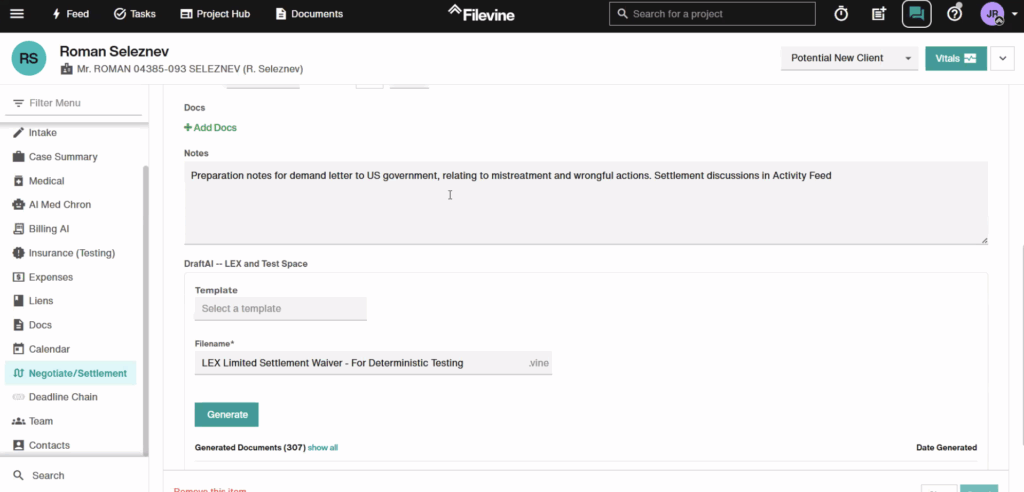
Behind the scenes, firms that already have their own in-house templates for demand letters, settlement agreements, labor contracts, loan terms, etc., can have those templates populated with information straight from the case files, using DraftAI. Select the type of document you need, click Generate, and a document assembly tool populates the template with information from the case file.

Applying AI to Document Generation
In the past, a lawyer or paralegal would then have to manually type hundreds if not thousands of words to fill out the specifics of the case. With DraftAI, it takes seconds.
Using what looks like a chatbot at the bottom right, users can ask Filevine to help complete the document. Depending on a firm’s configurations and integrations, Rizner noted, DraftAI can function as an enhanced version of ChatGPT or Microsoft Copilot that only uses information found in that case’s notes, text messages, emails, activity feed and uploaded documents.

He demonstrated a request for adding basic Whereas clauses that are specific to the case. Filevine dropped them into the document.
“Our AI tool looks at the document, looks at what actions can be taken, and tries to understand the user’s request,” Rizner said. “Then it applies them and highlights the changes it makes.”
The user can also ask it to make several changes at once. For instance, if you need every definition put in boldface type, you can type it into the chatbot.
The versions can be compared side by side, with each iteration saved in the system.

Drafting a Case Narrative
The system goes much further than modifying boilerplate.
Rizner said DraftAI reaches into every part of the Filevine case file to gather facts and help draft the narrative of the case.
He offered the example of personal injury firms in the early testing group that used DraftAI to generate fact sections in demand letters. At one, a paralegal needed to describe the mileage burden a client faced when attending medical appointments.
The information that supported the point was scattered across different areas of the case file, and DraftAI gathered it. This helped the paralegal estimate the value of the travel’s impact on the client to help write the proposed settlement.

“Instead of having to go through that process of sifting through the data, reviewing and writing, they can have this tooling kind of take those actions for them,” Rizner said.
Then attorneys can dedicate their time to reviewing and finalizing the document.
A Tool for Every Practice Area
Rizner said many of Filevine’s users have been personal injury firms, but DraftAI is designed to apply to every area of the law.

In the case of employment law, for example, firms always have similar starting points for a negotiation. DraftAI can pull in those details, along with notes about conversations from the case, interviews with the client and text messages with coworkers, to present the facts to a company.
DraftAI can include lists or tables in the document, and each section can be edited independently. Different permissions can be created to collaborate with others in the firm, giving lawyers total control over the finished product. The system is infinitely customizable to whatever a firm needs in any practice area, Rizner said.
Once a document is drafted, the action is tracked in FVDA/Outlaw. Every action going forward is tracked as the document is redlined within the system, and the same chat window can be used to query anything about the case.

It all happens within the secure environment of the Filevine space, Rizner said.
“Your case data remains with Filevine’s secure environment, which for our customers is important for the privacy and legal ethics that they require,” he said.
To schedule a personalized demo, click here.
The post How Filevine’s New DraftAI Cuts Out Hours Of Writing Work appeared first on Above the Law.
-

LongNosedGoblin Caught Snooping on Asian Governments
New China-aligned APT group is deploying Group Policy to sniff through government networks across Southeast Asia and Japan.
-

From Pilot To Playbook: How One Nonprofit Reaped The Benefits Of AI

What happens when a nonprofit embraces AI not for the hype, but for the help?
In the latest episode of the UpLevel View podcast, Brandi Pack and Ken Callander of UpLevel Ops sit down with Cristal Cardenas Sanchez and Marissa La Brecque of the nonprofit Hanna Center to talk about how their grassroots AI pilot turned into a full 2026 roadmap.
Keep It Simple (at First)
An effective start for your AI use involves a simple pen and paper. Here, Brandi shares her system for bringing in AI.
Transformative ROI
Hanna Center tracked the savings from its implementation of ChatGPT. Here, Cristal shares what the numbers show.
Taming Your Paperwork
A nonprofit like the Hanna Center, which has many layers of oversight, must complete large amounts of paperwork. Here, Marissa shares what’s changed since bringing on new technology.
Hear the Full Conversation
Curious to learn more? Check out this episode below.
The post From Pilot To Playbook: How One Nonprofit Reaped The Benefits Of AI appeared first on Above the Law.
-

Agentic AI Swarm Optimization using Artificial Bee Colonization (ABC)
 Using Agentic AI prompts with the Artificial Bee Colony algorithm to enhance unsupervised clustering and optimization workflows.
 -

ChatGPT Restrictions Explained: OpenAI Bans Personalized Professional Advice in 2025 Update
Have you ever asked ChatGPT a legal question, a medical “what does this mean,” or even a financial “should I do this?” If so, you may be surprised to learn that OpenAI has recently tightened the rules on these types of requests. The update provides clarity: ChatGPT can assist with understanding concepts and exploring ideas but cannot replace the expertise of licensed professionals….
By: Kohrman Jackson & Krantz LLP -
More Bank Charters, More Clarity
The OCC has granted conditional approval for five national trust bank (NTB) charters for institutions that will focus on innovative digital asset products and services. The approvals come at the end of the first year of the second Trump administration, as a wave of applicants seek the NTB charter for its federal preemption benefits and broad powers, and in anticipation of future GENIUS Act compliance. We expect OCC approvals for NTBs to continue and more applicants to pursue the strategy….
By: Davis Wright Tremaine LLP -
How Companies Can Roll with NY’s New Algorithmic Pricing Rules
States are racing to rein in the growing use of artificial intelligence and computer algorithms to set prices, with New York leading the charge. On Dec. 15, a major amendment to New York’s antitrust law took effect, banning the use of certain algorithmic rent-setting tools for residential units under Section 340-b of the state’s General Business Law….
By: Foley & Lardner LLP -
Federal Takeover of AI Governance? Breaking Down the White House’s New Executive Order — AI: The Washington Report
On December 11, President Trump signed an Executive Order (EO) titled “Ensuring a National Policy Framework for Artificial Intelligence.” The EO is designed to preempt much of the states’ authority over AI governance and constrain recent state-level efforts to regulate AI. Its issuance follows several failed attempts to pass AI federal preemption through federal legislation this year….
By: Mintz – Antitrust Viewpoints


