
Blog
RCS vs WhatsApp: Which channel is best for business messaging?

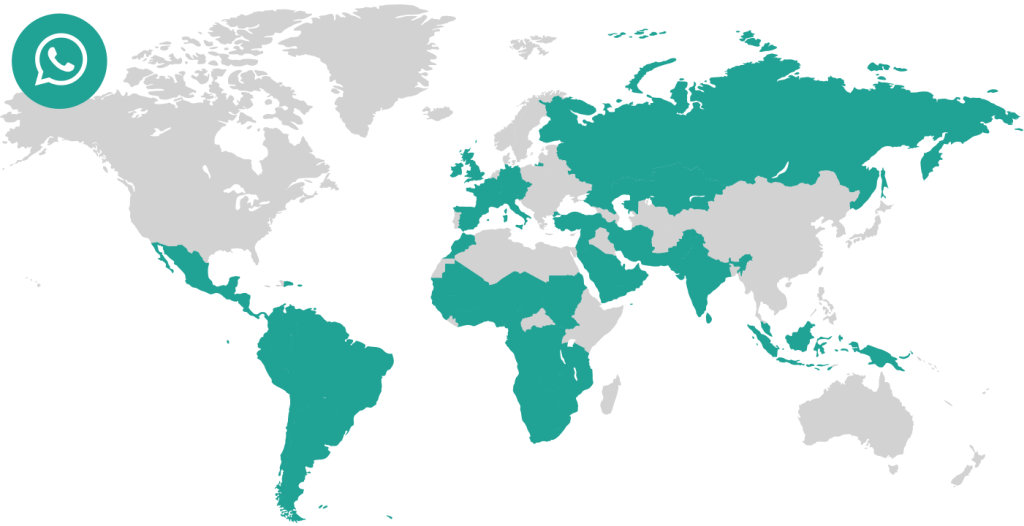
RCS and WhatsApp are the two richest business messaging channels, and the difference comes down to where the message lands. RCS (Rich Communication Services) delivers branded, interactive messages straight into a phone’s native text inbox, while WhatsApp reaches over three billion people inside the world’s most popular messaging app. Neither replaces the other – the right choice depends on where your customers are and what experience you want to deliver.
Both channels have changed fast. Apple now supports RCS on iPhone, end-to-end encryption is rolling out to person-to-person RCS chats between iPhone and Android following iOS 26.5, and WhatsApp moved to per-message pricing in July 2025. If you compared these channels even a year ago, your notes are out of date.
In this guide, we’ll compare RCS vs WhatsApp on reach, security, pricing, and business features, then walk through the use cases where each one shines – and when the smartest move is using both.
RCS vs WhatsApp: Understanding the basics
WhatsApp and RCS offer different paths to the same goal: richer, more engaging customer conversations than SMS can deliver. Here’s what each channel actually is.
WhatsApp: The world’s most popular messaging app
WhatsApp is owned by Meta and has more than three billion monthly active users across 180 countries. It’s the default way people communicate in markets like Brazil, India, and much of Europe, and it supports business and personal messaging with three solutions:
- WhatsApp Business Platform (API): For medium- to large-sized businesses with high-volume messaging needs.
- The WhatsApp Business app: For small businesses handling customer conversations manually.
- The standard WhatsApp app: For personal messaging between friends and family.

For businesses, WhatsApp offers verified profiles, message templates, WhatsApp Flows for in-chat forms and booking, and click-to-chat ads that start conversations from Facebook and Instagram. Brands must collect customer opt-in before messaging – and message quality is enforced, which keeps the channel’s engagement high.
“We see WhatsApp consistently drive engagement across regions, especially for high-frequency use cases like order confirmations and customer support.”

Bipin Patel
Product Leader at Sinch
RCS: Branded messages in the native mobile inbox
Rich Communication Services (RCS) is the messaging standard created by the GSM Association (GSMA) to modernize SMS and MMS. Google has been its biggest champion – Google Messages is the default RCS app on Android – but the standard itself belongs to the mobile industry, not to any single company. That’s a real difference from WhatsApp, which is one company’s app.
For consumers, RCS chat adds read receipts, typing indicators, high-quality media, and reactions to the native messaging inbox. For businesses, RCS for Business (previously called “RCS Business Messaging” or “RBM”) is the application-to-person (A2P) channel: branded, verified sender profiles, rich cards, carousels, and suggested replies, delivered where texts already arrive. Like WhatsApp, RCS for Business requires customer opt-in.
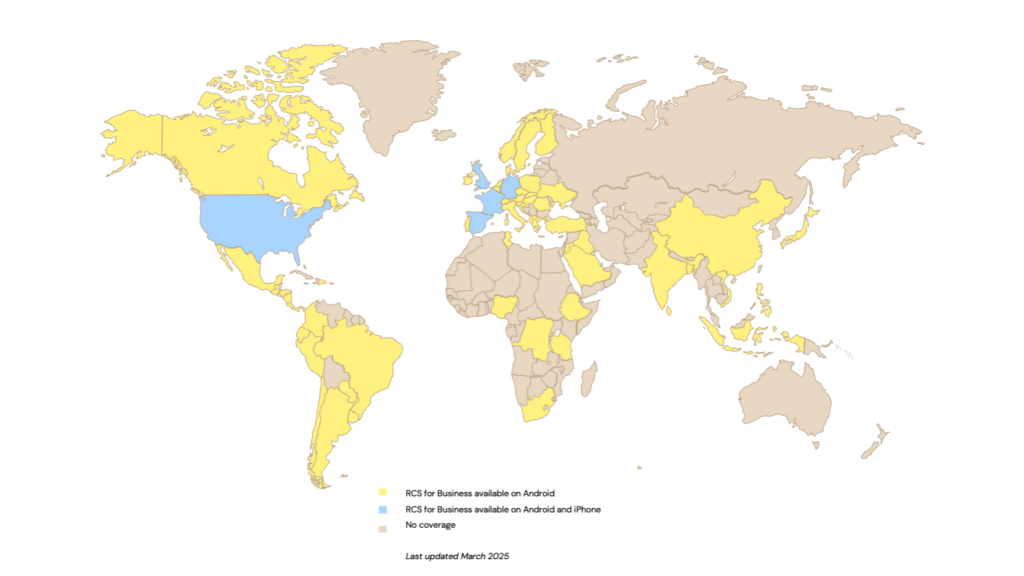
The channel’s reach story changed when Apple added RCS support in iOS 18 and kept building on it: with iOS 26.5, end-to-end encryption began rolling out to person-to-person RCS conversations between iPhone and Android under RCS Universal Profile 3.0. RCS now counts around 1.5 billion users globally – including 250 million in the U.S., where over a billion RCS messages are sent every day.
“With Apple rolling out support for RCS for Business, we know brands using it are experiencing much higher customer engagement, especially in markets where SMS is still dominant.”

Miriam Liszewski
RCS Commercial Product Manager at Sinch
RCS vs WhatsApp: Comparing the channels side by side
For person-to-person messaging, the two channels look similar: read receipts, group chats, typing indicators, rich media, and stronger security than SMS. For business messaging, they share a lot too – verified profiles, branded messages, carousels, and APIs for high-volume sending.
The differences are where your channel strategy gets decided:
| Feature | RCS for Business | WhatsApp Business Platform |
| Where messages land | Native messaging inbox – no app download needed. Android broadly; iPhone rollout is under way in key markets (carrier dependent) | The WhatsApp app – users must have it installed |
| Reach | 1.5 billion users globally (250 million in the U.S.), strongest in carrier-enabled markets like the U.S., U.K., France, and Germany | 3+ billion monthly active users, dominant in Brazil, India, and much of Europe, Latin America, Africa, and Asia |
| Security | Business (A2P) messages are encrypted in transit, not end to end. Person-to-person E2EE between iPhone and Android is rolling out following iOS 26.5 | Messages are end-to-end encrypted by default, including business conversations |
| Business features | Verified sender profiles, rich cards, carousels, suggested replies, in-inbox chat | Verified profiles, message templates, WhatsApp Flows, click-to-chat ads, catalogs |
| Pricing | Priced per message or per session; basic RCS messages are typically comparable to SMS | Per-message pricing since July 2025, by template category and country. Note: Meta has paused marketing templates to U.S. numbers since April 2025 |
| Fallback | Falls back to SMS when RCS isn’t available | No native fallback – pair with SMS or RCS via an API |
One thing the table can’t show: these channels don’t interoperate. An RCS message can’t land in WhatsApp or vice versa – which is exactly why most messaging strategies end up using more than one channel, with automatic fallback handling the gaps.
RCS vs WhatsApp: Which should your business use?
The honest answer to “which is better” is: it depends on who your customers are, where they live, and what experience you want to deliver. Here’s the decision framework we use with customers.
Choose RCS when:
- Your audience is in a market where texting is the default (the U.S., U.K., France) – RCS reaches the native inbox without asking anyone to download an app
- You’re upgrading an existing SMS program and want richer messages with SMS fallback built in
- Sender verification matters for trust – think banking alerts and one-time passwords
Choose WhatsApp when:
- Your customers are in WhatsApp-first markets like Brazil, India, or Mexico, where it’s simply where conversations happen
- You want conversational commerce features like Flows, catalogs, and click-to-chat ads
- End-to-end encryption by default is a requirement for your use case
Use both when:
- You operate across regions – route each message to the channel your customer actually uses
- You want maximum deliverability – a single API with cross-channel fallback means every message finds a way through
Where each channel shines: Four business use cases
Let’s make the framework concrete with common use cases and the results real brands are seeing.
1. OTPs and verification
One-time passwords (OTPs) keep customer accounts secure, and both channels improve on SMS verification:
- RCS OTPs come from verified sender profiles – users see your brand, not a random number – with SMS fallback for global reach.
- WhatsApp OTPs travel end-to-end encrypted and include copy-code buttons for a smoother login.
EasyPark Group, a leader in digital parking, sends RCS reminders and verification where supported and falls back to SMS everywhere else. The result? Delivery rates over 97% in Germany.

2. Personalized promotional messages
With open rates far beyond email, both channels are built for promotions that actually get seen – suggested replies, custom offers, and recommendations, all from a verified business profile.
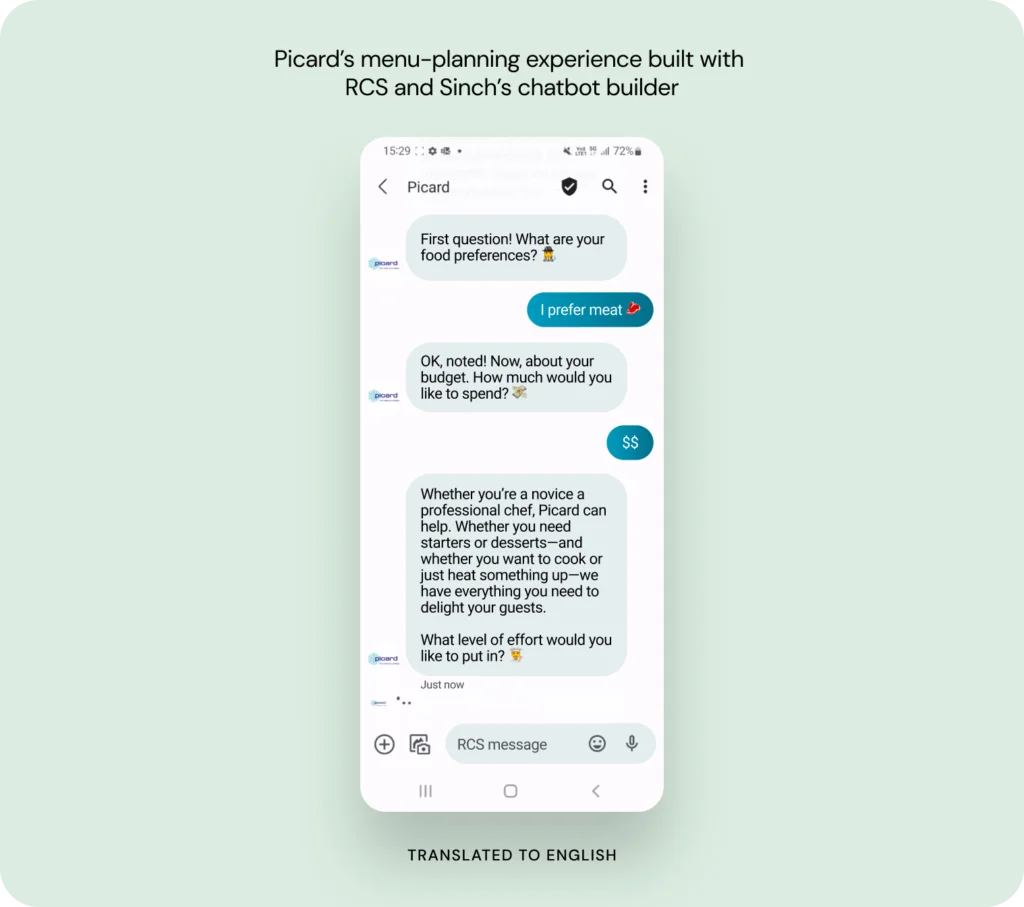
Picard used RCS to build a holiday menu planner that let customers share dietary needs and budget without leaving their native messaging app – and increased customer engagement by 42%.
On the WhatsApp side, Consórcio Magalu rebuilt its appointment scheduling with WhatsApp Flows and lifted both conversions and satisfaction.
One important caveat for U.S. marketers: Meta has paused templated marketing messages to U.S. WhatsApp numbers since April 2025, so U.S. promotional programs need customers to start the conversation – or need RCS. Read about the special WhatsApp marketing rules for the U.S.
3. Omnichannel campaigns
RCS and WhatsApp are powerful individually – and stronger together, as part of an omnichannel marketing strategy where each touchpoint amplifies the others.
BUT, a leading French home furnishing retailer, shows how. First they digitized their catalog experience with WhatsApp catalogs, letting customers build shopping carts in-chat. Then they turned to RCS for promotions: one campaign reached a 13.3% click rate and generated €61,000 in additional turnover – tripling the previous year’s results.
4. Customer service and support
Did you know 38% of consumers prefer handling customer service through mobile messaging channels?
In Brazil, iFood scaled support with a WhatsApp chatbot that now manages 45% of incoming inquiries, cutting delivery costs by 70% with a 91% satisfaction score from onboarded delivery staff. In France, Macif used RCS to re-engage five million insurance policyholders.
Same lesson, different geography: support works best on the channel your customers already open every day.
Frequently asked questions about RCS vs WhatsApp
Is RCS better than WhatsApp?
Neither is universally better – they win in different places. RCS reaches the native inbox with no download, which makes it strong in texting-first markets like the U.S. and much of Europe. WhatsApp owns daily conversation in markets like Brazil and India and offers deeper commerce features. Most global brands get the best results using both, routed by market.
Will RCS replace WhatsApp?
We wouldn’t bet on it. WhatsApp is more than a texting alternative – it’s voice and video calls, groups, communities, and commerce, embedded in daily life across huge markets.

Instead of waiting for one channel to win, think about how each one serves different customers today.
Does WhatsApp use RCS?
No. WhatsApp runs on Meta’s own infrastructure and protocol. RCS is the GSMA’s open standard, delivered through mobile carriers and native messaging apps like Google Messages and Apple Messages. They’re separate rails end to end.
Is RCS more secure than WhatsApp?
WhatsApp still holds the simplest security story: everything is end-to-end encrypted by default. RCS is closing the gap – end-to-end encryption for person-to-person chats between iPhone and Android is rolling out under Universal Profile 3.0 – but RCS for Business messages are encrypted in transit, not end to end. For most marketing and notification use cases both are a major upgrade over SMS; for sensitive data with strict compliance needs (think HIPAA or PCI), WhatsApp’s default encryption is the safer fit today.
Can I use RCS to message WhatsApp users?
No – messages don’t cross between the two channels. But an API layer can make that problem disappear: with Sinch Conversation API, you build a message once and it’s delivered over RCS, WhatsApp, or SMS depending on what each recipient can receive, with formats converted automatically behind the scenes.
Get started with RCS, WhatsApp, or both
The RCS vs WhatsApp question isn’t really a versus at all. The brands getting the best results – EasyPark, Picard, BUT, iFood – picked the channel their customers already use, and let fallback handle the rest.
Conversational messaging is how modern brands connect, support, and convert. With one integration through Conversation API, or no-code campaigns through Sinch Engage, you can run both channels from a single place.
Want to go deeper first? Explore these resources:
- What is RCS messaging? The complete guide
- RCS vs SMS: What’s the difference?
- RCS vs iMessage compared
- 22 smart ways to use WhatsApp Business API
- An enterprise guide to sending RCS messages via API
Ready to put the right message on the right channel? Reach out to our team – we’re here to help you build messaging experiences your customers will trust.
The post RCS vs WhatsApp: Which channel is best for business messaging? appeared first on Sinch.